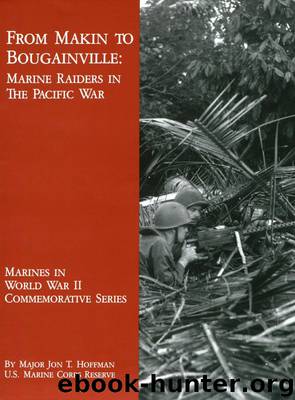
From Makin to Bougainville: Marine Raiders in the Pacific War by Jon T. Hoffman
Author:Jon T. Hoffman [Hoffman, Jon T.]
Language: eng
Format: epub
Tags: World War, 1939-1945 -- Campaigns -- Pacific Area, United States. Marine Corps. Marine Raider Regiment, 1st -- History, World War, 1939-1945 -- Amphibious operations
Published: 2015-04-27T04:00:00+00:00
[Sidebar (page 24):]
The Raider Training Center
The Raider Training Center got its start in late 1942, when the Major General Commandant authorized a slight increase in the table of organization of the newly formed 4th Raider Battalion. These additional two officers and 26 enlisted men became the cadre for the center, which formally came into being at Camp Pendleton, California, on 5 February 1943. The purpose of the center was to train new men up to raider standards and thus create a pool of qualified replacements for the battalions overseas. Prior to this, each raider unit had solicited fresh volunteers from other organizations in rear areas and then incorporated them directly into their ranks. Since most of these young Marines had only rudimentary training in weapons and tactics, the raiders had to expend considerable effort on individual instruction. Worse still, that old system provided no means to replace casualties during prolonged combat operations. Lieutenant Colonel Samuel B. Griffith II had been a prime proponent of the improved setup.
The course was eight weeks long. Carlson’s vision of the raiders initially influenced the training program, probably via Lieutenant Colonel James Roosevelt’s part in setting up the center. Their hands were obvious in the selection of classes on guerrilla warfare and “individual cookery.” The latter was a fetish of Carlson’s—he thought regular infantry relied too heavily on bulky field kitchens. There also was a week-long field problem in which the students divided into a main body and two guerrilla bands acting as aggressors. Rubber boat operations occupied a significant block of the schedule. Otherwise, the course focused heavily on traditional individual skills and small unit tactics: marksmanship, scouting, patrolling, physical conditioning, individual combat, and so forth.
Download
This site does not store any files on its server. We only index and link to content provided by other sites. Please contact the content providers to delete copyright contents if any and email us, we'll remove relevant links or contents immediately.
| Africa | Americas |
| Arctic & Antarctica | Asia |
| Australia & Oceania | Europe |
| Middle East | Russia |
| United States | World |
| Ancient Civilizations | Military |
| Historical Study & Educational Resources |
Cecilia; Or, Memoirs of an Heiress — Volume 1 by Fanny Burney(32721)
Cecilia; Or, Memoirs of an Heiress — Volume 2 by Fanny Burney(32089)
Cecilia; Or, Memoirs of an Heiress — Volume 3 by Fanny Burney(32066)
The Secret History by Donna Tartt(19471)
Sapiens: A Brief History of Humankind by Yuval Noah Harari(14553)
Leonardo da Vinci by Walter Isaacson(13514)
The Radium Girls by Kate Moore(12183)
Sapiens by Yuval Noah Harari(5450)
How Democracies Die by Steven Levitsky & Daniel Ziblatt(5322)
The Wind in My Hair by Masih Alinejad(5196)
Homo Deus: A Brief History of Tomorrow by Yuval Noah Harari(5018)
Endurance: Shackleton's Incredible Voyage by Alfred Lansing(4921)
Man's Search for Meaning by Viktor Frankl(4727)
The Silk Roads by Peter Frankopan(4668)
Millionaire: The Philanderer, Gambler, and Duelist Who Invented Modern Finance by Janet Gleeson(4602)
The Rape of Nanking by Iris Chang(4324)
The Motorcycle Diaries by Ernesto Che Guevara(4222)
Joan of Arc by Mary Gordon(4213)
Stalin by Stephen Kotkin(4070)
